

5 Key Macadamia Curing Principles That Preserve Value and Prevent Quality Loss
Macadamia curing is not simply a drying process.
It is a macadamia preservation process that directly determines final kernel quality, cracking performance, and market value.

Many of the most common macadamia quality defects farmers see during cracking and grading do not start in the cracking plant. They start in the macadamia curing room.
If you are experiencing problems such as brown centre macadamias, mould in curing bins, excessive kernel breakage, or inconsistent kernel colour, the root cause is often instability during curing.
Below are five essential macadamia curing principles, each directly linked to the most common curing problems seen in practice.
Key Macadamia Curing Principles Explored
1. Temperature Control in Macadamia Curing Must Be Stable, Not Maximised
One of the most common macadamia curing mistakes is pushing curing room temperature too high in an attempt to shorten curing time.
While higher temperatures increase drying rate, they also create thermal stress inside the macadamia kernel.
Macadamia quality problems linked to poor temperature control:
- Brown centre macadamias
- Kernel brittleness
- Higher kernel breakage during cracking
- Reduced shelf life and eating quality
Brown centre in macadamias is frequently associated with excessive or fluctuating curing temperatures, especially early in the curing cycle. The kernel tissue is damaged before moisture has migrated evenly from the centre to the surface.
In proper macadamia curing practice, temperature stability is more important than speed. Stable curing temperatures preserve kernel structure and reduce internal stress.
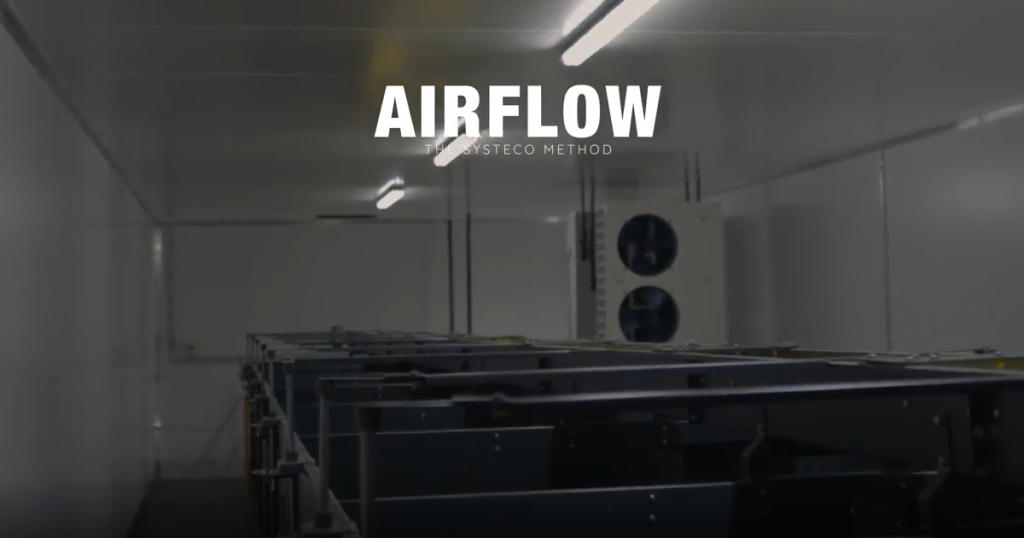
2. Airflow Is Critical in Macadamia Curing, Not Just Heat
Heat alone does not cure macadamias.
Airflow removes moisture.
In macadamia curing rooms, insufficient or uneven airflow allows moisture to accumulate around the nut surface, even if temperature appears correct.
Macadamia curing problems caused by poor airflow:
- Mould growth in curing bins
- Patchy curing within the same stack
- Uneven moisture content across bins
- Increased rehandling and re-curing
Mould in macadamias is often a direct result of inadequate airflow and high local humidity conditions within the curing room. When moisture is not removed consistently, fungal growth can begin before it is visible externally.
Uniform airflow across all curing bins is essential for consistent macadamia moisture reduction and mould prevention.
3. Stable EMC Is Essential for Macadamia Kernel Integrity
A key concept in macadamia curing science is Equilibrium Moisture Content (EMC).
In macadamias, many quality defects are caused not by drying itself, but by repeated changes in EMC during curing.
When curing room air temperature and relative humidity fluctuate:
- Moisture moves unevenly in and out of the nut
- Internal stress develops within the kernel
Macadamia defects linked to EMC instability:
- Brown centre
- Internal kernel discolouration
- Increased kernel cracking
- Inconsistent texture and flavour
Large EMC swings force the macadamia kernel to repeatedly absorb and release moisture. This weakens cell structure and increases susceptibility to cracking during later processing.
Effective macadamia curing aims to maintain a stable EMC environment, allowing moisture to migrate gently and evenly from the centre of the nut to the surface.
Without continuous environmental control and monitoring, EMC stability is extremely difficult to maintain.
4. Sufficient Curing Time Prevents Hidden Moisture Problems
Macadamia curing is not only about reaching a final moisture percentage.
It is about allowing time for internal moisture equalisation.
When macadamia curing is rushed:
- Surface moisture is removed too quickly
- Internal moisture gradients remain
- Kernel stress increases
Macadamia quality problems linked to insufficient curing time:
- Hidden internal moisture
- Delayed mould development after curing
- Increased breakage during cracking
- Variable kernel performance between batches
Some macadamia mould problems only appear later in storage or cracking, even when nuts initially seemed dry. This is often caused by internal moisture that was never allowed to migrate out fully during curing.
Proper macadamia curing requires time under stable conditions to ensure complete moisture migration and quality preservation.
5. Monitoring and Automation Prevent Silent Curing Failures
One of the biggest risks in macadamia curing is not detecting failures early enough.
Without continuous measurement and monitoring, curing problems can develop unnoticed for hours or days.
Macadamia curing failures linked to poor monitoring:
- Mould developing overnight
- Heating supply failures going undetected
- Fans running electrically but not moving air
- Temperature drifting outside safe curing ranges
Macadamia curing depends on knowing exactly what the curing environment is doing at all times.
This is where automation and monitoring systems in macadamia curing rooms become critical. Continuous measurement, alarms, and environmental control ensure deviations are detected immediately.
Automation does not replace proper curing principles.
It ensures those principles are applied consistently, 24 hours a day.
Most Macadamia Curing Defects Are Symptoms of Instability
Common macadamia curing defects, including:
- Brown centre macadamias
- Mould in curing bins
- Kernel breakage
- Inconsistent kernel colour
- Poor shelf life
are rarely isolated events.
They are usually symptoms of instability in:
- Temperature
- Airflow
- EMC
- Curing time
- Environmental control
A macadamia curing room should be treated as a controlled preservation environment, not simply a heated storage area.
Each curing cycle holds millions of rands worth of macadamias. Protecting that value depends on respecting these core curing principles batch after batch.
When macadamia curing is stable, kernel quality is stable.
When macadamia curing is unstable, quality losses follow quietly.
Contact us today Contact Systeco Group Today | Industrial Fabrication and Automation Solutions